


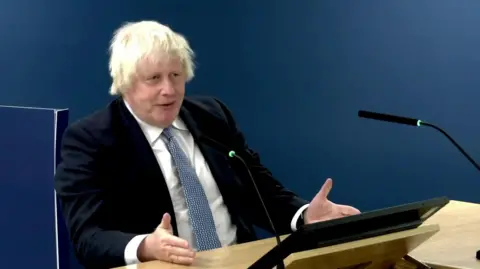
 Government Investigation Hearing
Children suffered a "significant toll" to safeguard society during the coronavirus crisis, the former prime minister has informed the inquiry studying the impact on youth.
The former leader repeated an apology expressed previously for things the administration erred on, but said he was proud of what instructors and schools accomplished to cope with the "extremely tough" situation.
He responded on prior claims that there had been no plans in place for closing down learning institutions in the initial outbreak phase, claiming he had assumed a "great deal of consideration and care" was by then going into those decisions.
But he said he had additionally hoped educational centers could stay open, describing it a "terrible concept" and "personal horror" to close them.
Prior Evidence
The inquiry was informed a plan was merely created on 17 March 2020 - the date before an statement that educational institutions were closing.
The former leader stated to the investigation on the hearing day that he accepted the feedback around the shortage of preparation, but added that enacting changes to learning environments would have demanded a "far higher degree of knowledge about Covid and what was expected to occur".
"The quick rate at which the disease was progressing" created difficulties to plan for, he added, stating the key priority was on striving to avert an "terrible medical emergency".
Conflicts and Assessment Grades Fiasco
The hearing has additionally heard previously about multiple conflicts between administration members, including over the judgment to close educational facilities a second time in the following year.
On that day, the former prime minister told the investigation he had wanted to see "mass testing" in schools as a method of maintaining them operational.
But that was "unlikely to become a runner" because of the new alpha type which emerged at the same time and accelerated the spread of the disease, he explained.
Among the largest problems of the outbreak for both leaders arose in the test scores disaster of summer 2020.
The schools authorities had been compelled to retract on its use of an system to assign grades, which was created to prevent elevated scores but which conversely saw 40% of predicted grades downgraded.
The public protest resulted in a U-turn which signified learners were eventually granted the scores they had been forecast by their teachers, after GCSE and A-level tests were cancelled beforehand in the time.
Reflections and Prospective Pandemic Preparation
Mentioning the exams situation, inquiry counsel suggested to the former PM that "the entire situation was a catastrophe".
"If you mean the pandemic a tragedy? Absolutely. Was the loss of schooling a catastrophe? Yes. Was the absence of exams a catastrophe? Yes. Was the letdown, anger, dissatisfaction of a considerable amount of young people - the extra anger - a disaster? Yes it was," Johnson stated.
"Nevertheless it has to be viewed in the framework of us trying to manage with a much, much bigger crisis," he added, mentioning the absence of schooling and exams.
"Generally", he stated the schools department had done a pretty "courageous effort" of attempting to manage with the outbreak.
Subsequently in Tuesday's proceedings, Johnson remarked the restrictions and separation rules "likely were excessive", and that children could have been exempted from them.
While "ideally this thing not occurs a second time", he stated in any future future outbreak the closing down of schools "genuinely ought to be a action of last resort".
This session of the Covid investigation, looking at the effect of the pandemic on youth and adolescents, is expected to finish in the coming days.
